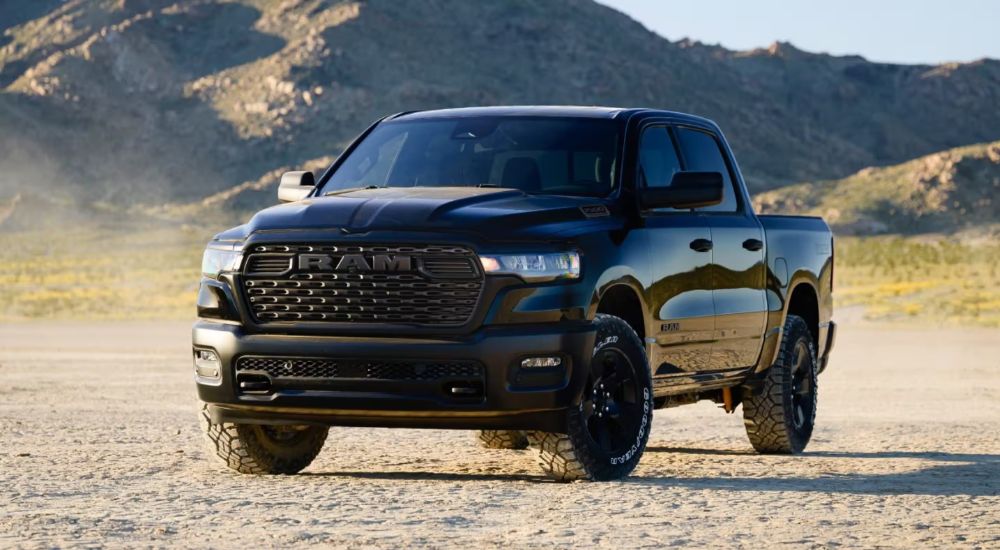
Ram is one of the biggest names in the competitive pickup segment, producing a full line of work-ready trucks that are distinguished by their tech-forward interiors and eye-catching style. It might not move as many units as the market’s leading model, but it’s a strong showing for a company that, technically speaking, didn’t exist 15 years ago. This timeline might cause a bit of confusion for those who aren’t well-versed in automotive history, but there’s a simple explanation. Many drivers still refer to the brand’s pickup as the Dodge Ram, but if you’ve been searching for a Ram 1500 for sale near Grand Ledge, you might have noticed that the Dodge name is nowhere to be found.
For much of its history, Ram represented Dodge’s truck-focused division. That all changed in 2010 when the two brands became separate entities, with Ram doubling down on its pickup approach and Dodge returning to its high-performance roots. This is just the latest change in a long series of mergers, buyouts, and corporate shakeups that have dramatically changed the company’s structure over the last 125 years. Let’s crack open the history books to see how both Dodge and Ram have weathered the last decade and what that means for their futures.
The Dodge Brothers Years
Sometimes, you’re just in the right place at the right time. As the 19th Century gave way to the 20th, Detroit, Michigan, was the center of the automotive world. The Motor City was to the auto market what Florence was to Renaissance Art or what Silicon Valley is to the tech industry. It was in this exciting atmosphere that two brothers founded an unassuming machine shop in the city’s Greektown neighborhood. John and Horace Dodge initially made metal parts for typesetting machines and boat engines, but soon expanded into engine and transmission components under contract from Oldsmobile.
Booming business allowed the brothers to expand into a larger facility in 1903 and take on more work from a fledgling brand, the Ford Motor Company. Auto visionary Henry Ford was particularly fond of the brothers’ work and soon tasked the Dodges with building almost the entire Model A line. This close relationship with Ford would pay dividends for the Dodge brothers, who soon gained a 10% stake in the automaker. While those shares would be worth almost $5 billion in 2026 terms, the 10% payment was exchanged for less than $400,000 of goods.
After a decade of subcontracting for Ford, the brothers struck out on their own to form the Dodge Brothers Motor Company in 1913. The Dodge Model 30-35 would represent the brand’s first homegrown effort. It impressed drivers with its all-steel body, 12-volt electrical system, and a 35-hp engine that was 75% more powerful than the motor found in Ford’s Model T. The Model 30-35 quickly established Dodge as a force to be reckoned with in the burgeoning auto industry, and that reputation would soon extend to the truck segment. The company’s early pickups saw extensive use in harsh desert conditions during the Mexican Border War, and more than 12,000 Dodge cars and trucks were also used during World War I. In fact, Dodge was the U.S. military’s primary source of light-wheeled vehicles until World War II.
Becoming a Chrysler Brand
Dodge would rank second in U.S. auto sales by 1920, but would drop to 13th by 1927 following the deaths of both founding brothers. Dodge was sold to the Chrysler Corporation in 1928, marking the first in a long string of ownership changes. Chrysler would simplify its lineup as Dodge attempted to compete in an increasingly crowded auto market, but wartime would give the brand another chance to solidify its reputation, as it produced over 400,000 trucks and ambulances for the U.S. military during World War II. The real star of the show would be the WC-series trucks, which, after the war, would pave the way for the civilian-grade Dodge Power Wagon. The post-war era also saw Dodge debut a V8 engine that would eventually lend its name to an entire standalone brand.
In 1950, Dodge introduced its first V8, which the company dubbed the Red Ram HEMI. While this innovation would pave the way for the Ram brand we know today, Dodge wasn’t really a truck specialist at this point in its history. Until the early 1970s, Dodge was a full-line automaker producing trucks, sedans, wagons, and even early performance trims that would eventually become some of the market’s first muscle cars in the Charger, Coronet R/T, and Super Bee.
The 1970s oil crisis would bring big changes to the Dodge brand, but not quickly enough. The company’s larger, relatively inefficient models became a much harder sell in a market increasingly driven by fuel economy. While other automakers quickly retooled their lineups, cash-strapped Chrysler lagged behind.
Dodge did make up some ground with subcompact models like the Omni, but by 1978, the brand was petitioning the government for bankruptcy protection. Dodge would get its wish thanks to the efforts of Chrysler executive Lee Iacocca, and the brand would soon start producing efficiency-minded K-cars, such as the Aries. The next decade would see Chrysler craft a wholly original automotive creation in the Dodge Caravan, which is widely regarded as the market’s first minivan. The Caravan would soon replace the station wagon as the go-to choice for modern families, and played a major role in Chrysler’s survival.
Enter Ram
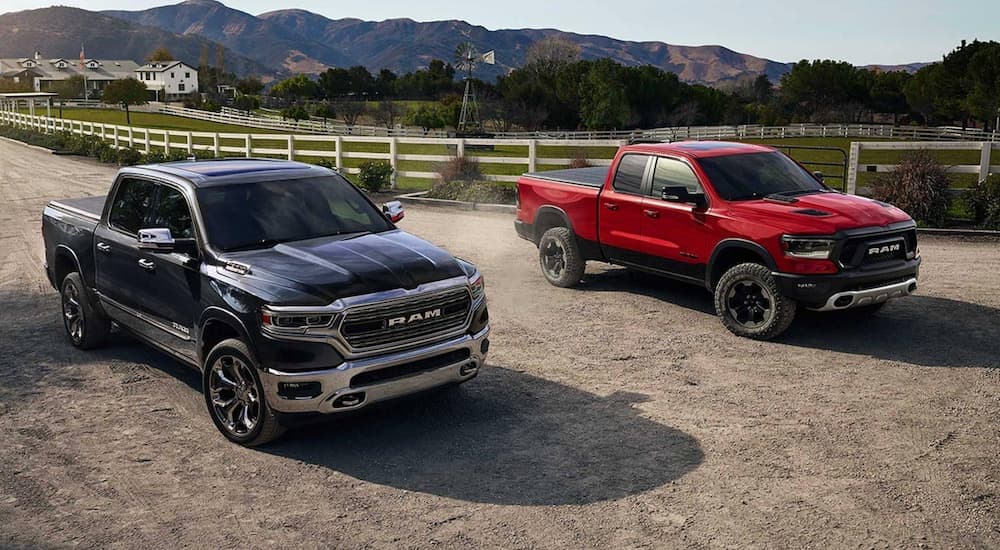
The minivan might have saved Chrysler in the short term, and the Daytona, 600, and Viper allowed Dodge to maintain its reputation for performance engineering, but it was the 1980 debut of the Dodge Ram that would really reverberate through history. First hitting the streets in late 1980, the original Dodge Ram was offered in half-ton, 3/4-ton, and one-ton configurations. The Ram represented Dodge’s full-size offering, but it wasn’t significantly distinguished from the rest of the lineup, which also included midsize pickup options like the Dakota and the compact D50.
That would all change in 1994 when the second-generation model hit the market. The redesigned Dodge Ram was nothing less than a revelation when it was first introduced, largely thanks to its unique styling. While previous pickups had stuck to a classic, boxy formula, the Dodge Ram’s modern design adopted a more aerodynamic look while still conveying its work-ready intentions.
The Dodge Ram quickly became a favorite amongst drivers and critics alike and even earned a star turn as the “hero vehicle” in 1994’s Twister and the CBS television series Walker, Texas Ranger. The truck’s performance potential, combined with a savvy marketing effort, saw Dodge move some 400,000 units in both 1995 and 1996,
The Ram represented a promising new direction for the Dodge brand, but things were becoming increasingly tumultuous at the corporate level. Chrysler merged with Daimler-Benz AG in 1998 to form DaimlerChrysler, a move that eventually spelled the end for Dodge’s sister brand Plymouth. With Plymouth gone, Dodge increasingly became both Chrysler’s mainstream value brand and its performance division.
It was an unusually broad role for a single brand, and not always successful. Models like the Dodge Stratus suffered from low sales, while newer products such as the Dodge Caliber and Avenger struggled to gain traction. At the same time, Dodge found renewed enthusiasm in the performance sector with the revived Dodge Challenger. But broader economic pressure was mounting. The DaimlerChrysler merger failed to produce the expected cost savings, and rising legacy costs tied to pensions and health care, combined with weakening sales, put increasing strain on the company. In 2007, DaimlerChrysler sold a majority stake in Chrysler Group, including Dodge, to Cerberus Capital Management. The timing couldn’t have been worse.
A Three-Headed Beast
The 2008 global financial crisis might have been caused by the collapse of the U.S. housing bubble, but it had a dramatic effect on almost every industry. This was especially true of the U.S. auto industry, which, to make matters even worse, was also being racked by a perfect storm of economic challenges. High global demand, supply constraints, and financial speculation saw oil prices almost double, with the average cost per gallon of gas rising to $4.10 in the late 2000s.
It was a bad time to be in the auto business, especially if you’re known for producing larger, thirstier vehicles and performance models. The Chrysler Group’s gas-guzzling trucks and SUVs would suddenly and dramatically go out of vogue, but gas prices weren’t the only factor facing Cerberus. In addition to being a largely truck- and performance-based brand, Dodge was known for its low-barrier financing. This strategy might have worked well in a more prosperous era, but credit markets began to balk at subprime financing, given the havoc it had wreaked on the housing market.
Cerberus’s investment was starting to look dicey as auto sales collapsed, leading Chrysler LLC and General Motors to both file for Chapter 11 bankruptcy protection in 2009. A $15.5 billion government bailout kept the company afloat, but also triggered a major restructuring that saw Chrysler close thousands of dealerships, shut down factories, ramp down production, cancel planned products, and overhaul corporate leadership.
Fiat to the Rescue
It was a dark time for the historic brand, and could have spelled the end for Chrysler if not for a little Italian intervention. Fiat teamed up with Chrysler and the United Auto Workers union (UAW) during the bankruptcy process, with CEO Sergio Marchionne seeking to get the brand back into la dolce vita. Marchionne took a much-needed machete to the ailing company, carving Chrysler into more manageable, bite-sized parts. The first step was giving each Chrysler brand its own unique focus. That meant returning Dodge to its high-performance roots by axing models like the Dart and Avenger in favor of genuine American muscle cars like the Charger, Challenger, Viper, and their SRT/Hellcat variants.
The titular Chrysler brand also narrowed its offerings, evolving from a full-line automaker into a specialty brand with a premium, family-friendly focus. The 300 sedan and Pacifica minivan held strong, but other models like the Sebring, PT Cruiser, and Aspen all left the lineup by 2010. Jeep was the only Chrysler brand to escape relatively unscathed, retaining its off-road focus and continuing to drive sales during the downturn. That left just one Chrysler brand to worry about: the company’s Ram trucks division.
Dodge No More
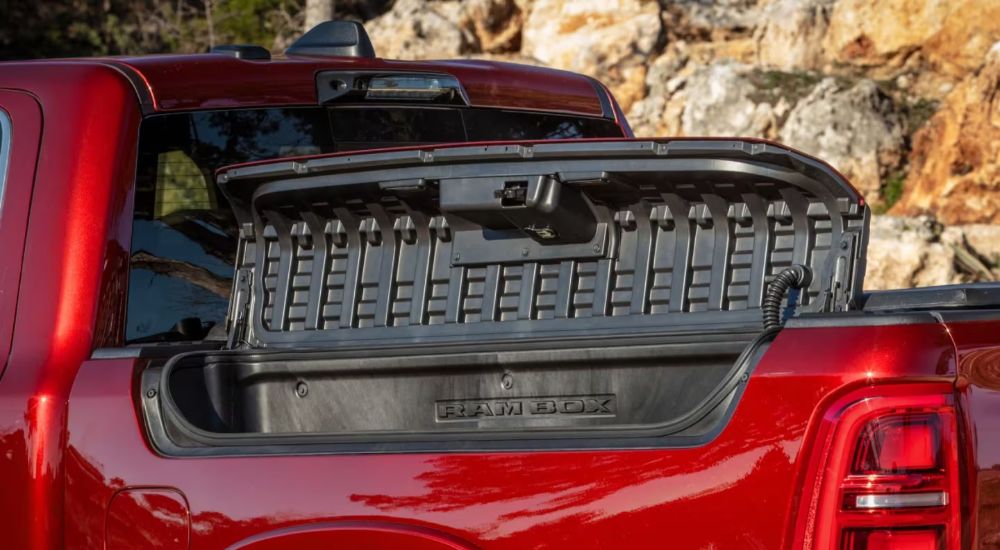
Dodge Ram trucks had long occupied the third spot on the pickup podium, with annual sales that lagged well behind first-place Ford and the silver medalist in GM. Brand loyalty runs particularly high in the pickup segment, and while Dodge was producing some compelling trucks, it simply couldn’t compete with the success of models like the F-150 and Silverado 1500. By spinning Ram off into its own standalone marquee, Marchionne hoped to build a stronger brand identity that would allow the badge to better compete with its pickup rivals. The Italian exec saw distancing Ram from Dodge’s muscle car image as an easy way to buoy the brand’s fortunes, and Ram Trucks was born.
In addition to light- and heavy-duty pickup options in the Ram 1500, 2500, and 3500, the new standalone brand also introduced a homegrown commercial van in the Ram ProMaster. Prior to the restructuring, Dodge had simply sold a rebadged version of the Mercedes-Benz Sprinter dubbed the Dodge Sprinter. This model was replaced with the Ram ProMaster, which was itself based on the Fiat Ducato.
The rebrand worked, with Ram’s truck lineup representing one of Chrysler’s most profitable brands throughout much of the 2010s. It was nothing short of a miracle on Fiat’s part, which continued to take an increasingly large stake in Chrysler. By 2014, the storied American automaker was a wholly-owned subsidiary of Fiat, which was rebranded as Fiat Chrysler Automobiles (FCA). Unlike Cerberus, FCA saw a quick return on its investment, with Ram sales quickly surging. In fact, Ram even began to challenge Chevy for the number two spot, with 293,000 sales to the Silverado’s 418,000. That gap shrank to just 50,000 trucks by 2018, largely spurred by changing consumer habits.
Trucks were bigger and better than ever, but also more luxurious. Ram’s potent, diesel-powered heavy-duty models and its penchant for premium design gave the brand a clear edge over its more utility-driven competitors, and by 2019, the automaker finally nabbed second place. The Ram 1500 repeated this success in 2021, and also saw the latest in a long string of mergers and name changes. FCA merged with France’s Groupe PSA in 2021 to become the world’s fourth-largest automaker. The newly minted Stellantis is now a global melting pot of brands ranging from Italy’s Fiat, Alfa Romeo, and Maserati to France’s Peugeot and Citroën, Germany’s Opel, and England’s Vauxhall.
Ram on the Grow
It hasn’t been an entirely easy path for the newly formed Stellantis, which replaced its CEO after a 70% drop in net profits back in 2024, but Ram is a different story. The brand is still holding steady in third place, though it has yet to break the records it set in 2019 and 2021. Still, it’s an exciting time for the truck-specific brand, which is eagerly adopting new technologies to keep Ram relevant in a rapidly changing market.
Ram wasn’t the first to wade into the EV pickup wars, and that looks to have been a very fortuitous decision as Ford and Chevy struggle to move their own electrified pickups. Ram has opted for a different strategy with the 2026 Ram 1500 REV, an extended-range electric vehicle (EREV) that represents the sweet spot between hybrid and EV technology. The pickup packs a 3.6L V6, but instead of driving the wheels, it’s simply tasked with charging the battery used to power the REV’s electric motors. It’s an innovative strategy intended to alleviate range-related anxiety, and the industry has taken notice. Ford is already copying off Ram’s homework, and is set to replace the underwhelming F-150 Lighting with an EREV model in the near future. Ram has also been a leader in hybrid technology, introducing the eTorque mild-hybrid system as far back as 2019. Add in a fresh slate of turbocharged V6 options that can tow more than 11,000 lbs while logging 21 MPG combined, and it’s fair to say that Ram understands the needs of modern pickup drivers.
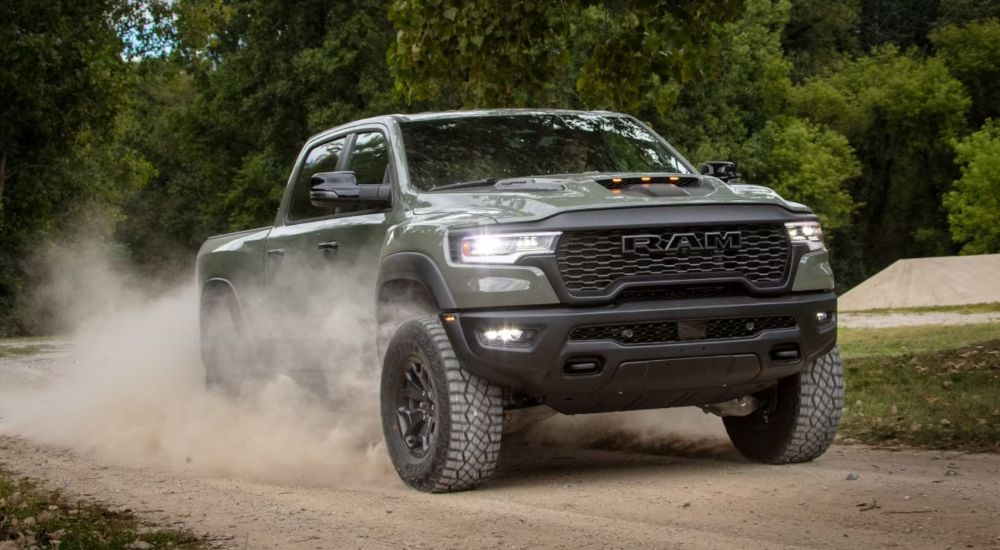
Enjoy the Latest Ram at LaFontaine Chrysler Dodge Jeep Ram Lansing
From bankruptcies and mergers to fuel crises, housing bubbles, and shifting consumer tastes, the Ram brand has been through a lot. There have certainly been some rocky periods over the last 100 years, but a commitment to continuous innovation has served the automaker well, allowing Ram to adapt while other brands faded into obscurity. The decision to break up the established Chrysler brands might have seemed like a risky gambit at the time, but it allowed both Dodge and Ram to establish their own distinct identities without losing the personality, attitude, and spirit of performance that underlie every model. It’s an inspiring story of resilience, and one that would certainly make John and Horace Dodge proud. If you’re ready to see what a century of innovation feels like, the full Ram lineup is waiting for Grand Ledge drivers here at LaFontaine Chrysler Dodge Jeep Ram Lansing.
Posted in
Ram 1500 for Sale Near Grand Ledge |
No Comments »