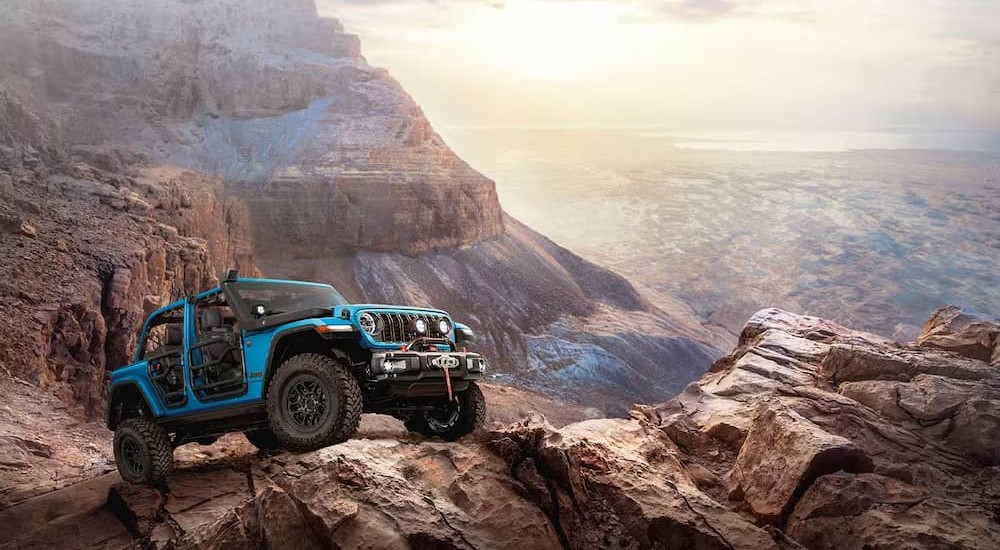
The Jeep Wrangler and Ford Bronco are two of America’s most popular midsize SUVs for adventure seekers, combining everyday drivability with the capability to tackle rugged terrain when the pavement ends. While both SUVs are built to tackle the toughest driving conditions, each is also adept at navigating urban roadways with ease, offering comfortable rides, precision handling, and upscale amenities that keep drivers connected and engaged.
However, though both SUVs are capable 4WD machines, the 2026 Jeep Wrangler offers a unique package of features and capabilities that help it stand out from its competition, including the Bronco. If you’re trying to decide between a Ford Bronco or a Jeep Wrangler for sale, it’s a good idea to perform a point-by-point deep dive into each vehicle’s features and capabilities.
Below, we cover key considerations for both the Wrangler and the Bronco, highlighting the Jeep’s superiority as a city-friendly, off-road-capable SUV.
Powertrain Comparison
Ford Bronco
The standard engine in the Ford Bronco is a turbocharged 2.3-liter EcoBoost I-4 that generates up to 300 hp and 325 lb-ft of torque. There’s also an available 2.7-liter EcoBoost V6 turbo that produces up to 330 hp and 415 lb-ft of torque.
The off-road-focused Raptor trim features an exclusive 3.0-liter EcoBoost turbo engine that delivers 418 hp and 440 lb-ft of torque. All Bronco trims come standard with 4WD and a 10-speed automatic transmission. However, the base engine in the lineup offers a seven-speed manual transmission.
Though raw output is impressive across the Bronco lineup, those numbers don’t necessarily translate to superior capability. For example, the top-of-the-line Raptor has only 4,500 lbs of maximum towing capacity, while the remainder of the Bronco trims can claim only 3,500 lbs.
That is significantly less than the Wrangler’s 5,000 lbs maximum towing capacity across the lineup of trim levels, with only the Moab 392 claiming a maximum towing capacity that is as low as the standard Bronco’s capacity.
Jeep Wrangler
Under the hood of the 2006 Jeep Wrangler is the time-tested 3.6-liter Pentastar V6, the standard engine option. It generates up to 285 hp and 260 lb-ft of torque that’s delivered to either a six-speed manual transmission or an eight-speed automatic gearbox.
There’s also an optional 2.0-liter turbocharged I-4 that provides up to 270 hp and 295 lb-ft of torque, paired with an eight-speed automatic transmission. There’s even a 6.4-liter HEMI V8 that is exclusive to the Moab 392 edition of the Wrangler, and it provides eye-popping production of up to 470 hp and 470 lb-ft of torque.
For drivers seeking maximum horsepower and torque production, the clear winner is the Wrangler in the Moab trim. Its horsepower and torque numbers are higher than the comparably priced and similarly equipped Raptor’s horsepower and torque output, making it one of the most powerful, capable midsize SUVs available. For the ultimate off-roader who wants power and capability, the Wrangler is the answer.
Off-Road Capability
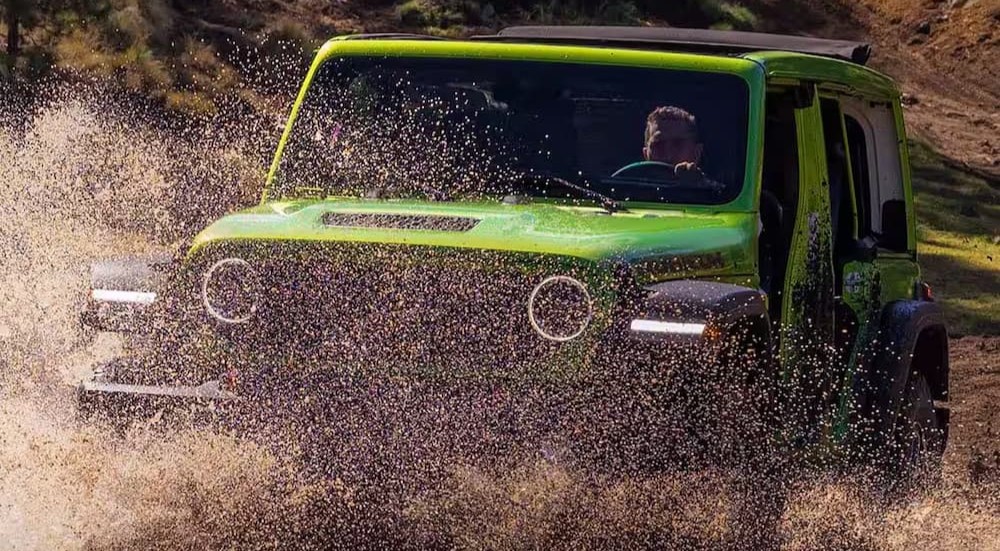
Both the Wrangler and Bronco are clearly built to handle off-road driving, but the Wrangler has clear advantages, giving it greater mud-bogging, creek-fording, and rock-climbing capability than the Bronco. The off-road lineage of both vehicles is obvious, but the terrain-friendly features of the Jeep go well beyond rugged appearance and adventure accessories.
Advanced 4WD Systems
It begins with the drivetrain. While the Bronco offers standard 4WD across its trim levels, the Wrangler offers greater 4WD flexibility thanks to terrain-tackling features like Command-Trac and Rock-Trac. Command-Trac provides part-time 4WD with 2WD, 4WD High, 4WD Low, and Neutral modes. This provides a perfect balance between on-road efficiency and off-road capability, and it’s great for commutes in traffic as well as driving in snowy or rainy conditions.
Rock-Trac, standard on the Rubicon trim, provides the ultimate off-road capability. While Rock-Trac-equipped Jeeps still perform well during routine driving on streets and highways, they add the impressive ability to perform technical and aggressive off-road maneuvers.
The 4:1 gear ratio provides for more torque when crawling over obstacles at low speeds, and the Tru-Lock automatic locking differentials and electronic disconnect sway bar allow maximum articulation when navigating uneven terrain.
Ground Clearance and Angles
The Jeep’s ground clearance and angles are also better, which contributes to the Wrangler’s superiority over the Bronco in off-road conditions. The standard ground clearance of the Jeep is 9.7 inches on the Sport trim, which is more than the 8.4-inch clearance of the standard Bronco.
While departure and approach angles are almost identical in the Bronco and Wrangler, the Jeep has a higher breakover angle by three degrees. That’s important when crossing obstacles, as the breakover angle is the maximum angle a peak or ridge a vehicle can cross without scraping the underbelly.
When these factors are considered, it’s clear that while the Bronco and Wrangler have similar on-road performance, when the pavement ends, the Wrangler offers superior off-road and crawling capabilities on extreme terrain.
Fuel Efficiency
Fuel efficiency varies by powertrain, equipment, and accessories, but in direct comparisons, the Jeep Wrangler still edges out the Ford Bronco in overall fuel economy. When both 4-door models are compared in their entirety, the Wrangler is the more fuel-efficient of the two, making it better suited for everyday driving purposes.
When the Wrangler is equipped with the 2.0L turbocharged engine, it has an EPA-estimated fuel economy of 20 MPG in the city, 23 MPG on the highway, and 21 MPG combined with 4WD. Compared to the Bronco, the 2.7L EcoBoost has an estimated fuel economy of 19 MPG in the city, 21 MPG on the highway, and 20 MPG combined.
With better fuel mileage, the Wrangler is well-suited for urban and off-road driving, and its excellent fuel economy means you’ll spend less time at the gas pump and more time chasing adventure wherever it leads.
Infotainment Technology
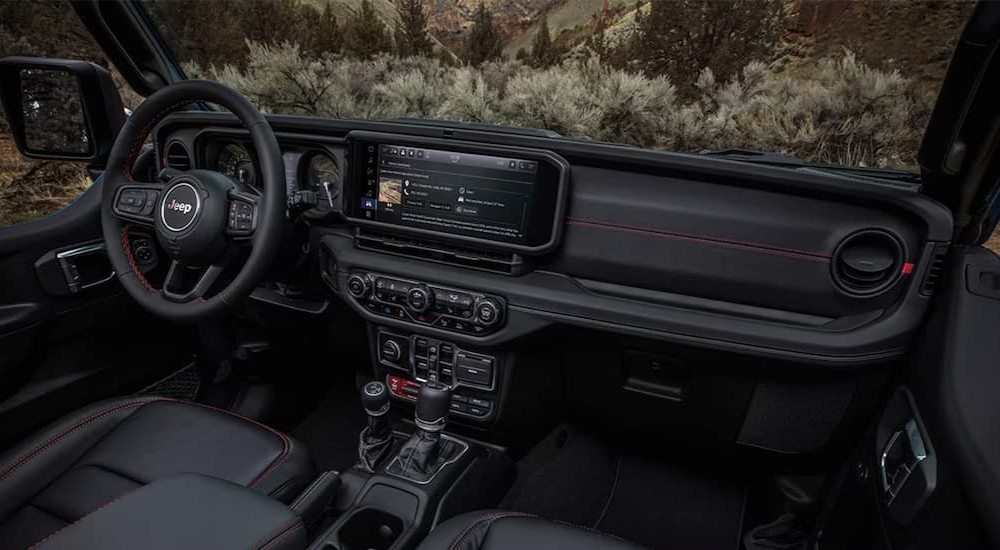
Though the Bronco has a larger standard digital instrument display than the Wrangler, the Jeep has a superior touchscreen infotainment display.
The Wrangler’s 12.3-inch screen is slightly larger than the Bronco’s 12-inch display, and the Uconnect 5 system, which serves as the Wrangler’s infotainment hub, is considered by many to be superior in terms of intuitive design, user-friendliness, and reliability.
The Wrangler’s Uconnect 5 platform also offers standard built-in navigation in more trim levels, and the Jeep’s eight-speaker audio system one-ups the Bronco’s seven-speaker standard sound system. Another helpful feature that makes the Wrangler the better choice for serious off-road aficionados is the standard off-road trail apps included in the Jeep. In contrast, similar apps are available only as options in the Bronco.
Pursue Adventure With the Jeep Wrangler
For true adventure seekers, there’s little question whether the Wrangler or Bronco offers superior off-road performance combined with everyday driveability. With powerful and reliable powertrain options, innovative all-terrain features, world-class infotainment technology, and practical fuel efficiency, the Jeep Wrangler offers a well-rounded driving experience. It’s an ideal vehicle for drivers who commute through the suburbs during the week and head for the hills on weekends for serious off-road fun.
While the Bronco’s retro design and top-trim features are attractive to some drivers, the Jeep is the original off-road SUV, and true off-road driving enthusiasts love the combination of everyday practicality, high-end comfort, and unmatched capability offered by the legendary Jeep brand.
Posted in
Jeep Wrangler for Sale |
No Comments »